News
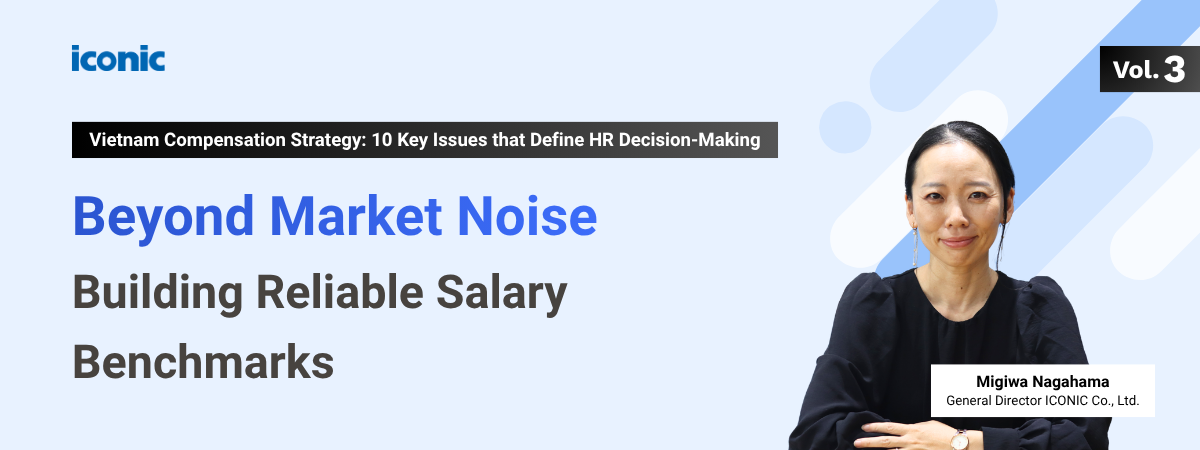
Vol. 3 | Beyond Market Noise: Building Reliable Salary Benchmarks
In Vol. 2 - Pay Compression in Vietnam: When New Hire Salaries Catch Up with Existing Employees - we examined how the salary gap between long-tenured employees and recent hires gradually narrows, and how organizations can address this more strategically within their compensation review processes.
This edition focuses on a closely related issue: why salary data from recruitment markets tends to run higher than actual practice - and what organizations should look for when building reliable compensation benchmarks.
The right data depends on the right purpose
Job postings, employer review platforms, and salary guides published by recruitment firms are among the most accessible sources of compensation data in Vietnam.
For reference purposes - such as calibrating offers during hiring or developing a general sense of market movement - these sources serve a legitimate role. However, when used to design internal salary structures or determine annual merit increase budgets, the nature of the underlying data matters significantly. Understanding what each source actually measures, and which population it reflects, is a prerequisite for sound compensation decision-making.
Why recruitment market data tends to run high
Three structural factors consistently push recruitment market figures above the salary levels organizations are actually paying.
The sample is limited to employees actively seeking new opportunities.
Vietnam's annual turnover rate typically sits between 10–20%, which means more than 80% of the workforce is staying put — and not appearing in any recruitment dataset. The figures that surface in job boards and salary guides reflect the expectations of a self-selected group actively seeking upward movement, not the compensation reality of the broader labor market.
Self-reported salary data carries a built-in upward bias.
When compensation data is sourced from employer review platforms, professional networks, or candidate-declared salaries, the underlying incentive structure tends to push figures higher. From a behavioral economics perspective, individuals naturally set higher salary anchors to strengthen their negotiating position in future discussions. Compounding this, total compensation - including bonuses and allowances - is frequently reported interchangeably with base salary, inflating figures further. This pattern of systematic overstatement in self-reported compensation data is well-documented in global Total Rewards research.
Posted salary ranges create a misleading impression of the market midpoint.
Job postings are designed to attract candidates, which means they typically display the full range — including the ceiling reserved for exceptional hires. In practice, most positions are filled closer to the minimum of the advertised range. When the midpoint of a posted range is used as a market reference, perceived "market salary levels" are pulled materially higher than actual hiring outcomes - and if this figure is used to update internal salary structures, the entire compensation framework risks being calibrated against a distorted baseline.
Where these distortions create real problems
The consequences of misreading compensation data tend to show up in two specific places.
Salary structures set higher than necessary. When recruitment market data is used as the primary reference for salary range updates, the result is often a structure that sits above actual market practice — inflating hiring costs, pressuring total payroll, and quietly accelerating the pay compression dynamics covered in the previous issue.
Reduced credibility in internal salary conversations. When employees raise salary adjustment requests citing job board figures or what peers are reportedly earning, organizations that only have recruitment market data to work with struggle to respond with confidence. Access to actual pay data — drawn from the full workforce, not just those in transition — allows HR and business leaders to engage these conversations on more solid ground, grounded in evidence rather than competing anecdotes.
What reliable compensation benchmarking actually looks like
Compensation surveys that collect actual pay data directly from participating organizations offer a fundamentally different reference point from recruitment market sources.
Rather than capturing what candidates declare or what companies advertise, these surveys aggregate what organizations are genuinely paying — and present the results as a statistical distribution: where P25 sits, where the median falls, where P75 lands. That distribution gives organizations a clear, market-grounded view of their salary positioning — one that is not inflated by negotiation dynamics or advertising incentives.
When evaluating which surveys to rely on, several criteria consistently matter:
Actual pay data, not advertised or declared figures. The foundation should be what organizations are paying employees today — not what candidates hope to earn or what job postings suggest.
Independent collection and validation. Data gathered and verified by a third party — with outlier checks and year-on-year consistency controls — carries substantially more weight than self-submitted figures.
Sufficient sample depth. Datasets drawn from a small number of participants are statistically fragile and more vulnerable to distortion from individual outliers.
A representative peer group. Benchmarking against organizations that differ significantly in industry, geography, or scale risks producing conclusions that simply do not apply to your context.
Explainability to leadership. In practice, the ability to clearly articulate the source and methodology behind compensation data is essential — whether presenting a salary proposal internally or seeking budget approval from senior leadership.
Data from organizations, for organizations
The Vietnam Salary Survey 2026 collects actual pay data directly from participating companies — capturing the full workforce, including long-tenured employees, not just those in active job transition. That breadth is what makes the data useful not only for market positioning analysis, but also for responding to internal salary discussions with a defensible, evidence-based perspective.
Now in its 17th year. 392 participating companies last year. Participating organizations receive complimentary access to summary results, along with a range of additional benefits.
📍 Next Issue (Vol. 4) "Your Talent Competitors May Not Be in Your Industry"
When benchmarking compensation, most organizations default to comparing against peers within the same sector. But depending on the role and level, the real competition for talent often crosses industry lines — and a purely sector-specific lens may be leaving your organization's true competitive exposure unexamined. Next week, we will explore which roles and levels are most vulnerable to cross-industry talent competition, and what that means for how you benchmark.