News
Vol. 4 | Your Talent Competitors May Not Be in Your Industry
In Vol. 3, Beyond Market Noise: Building Reliable Salary Benchmarks - ICONIC explored why salary information from recruitment platforms often exceeds actual market pay levels and shared key criteria for identifying reliable benchmark data.
This week, we explore a question that directly affects how companies benchmark compensation: Who are you actually competing with for talent?
For many roles, the answer goes beyond your own industry. Understanding this distinction is critical, because industry-only benchmarks may not fully reflect the talent market you are competing in.
Is “Same Industry” Really a Complete Benchmark?
When evaluating whether compensation is competitive, most organizations naturally begin by comparing themselves with companies in the same industry. It's a sensible starting point—but it may not tell the whole story.
The companies competing for your talent are not necessarily the same companies competing for your customers. Depending on the role and seniority level, your target candidates may also be pursued by employers from very different sectors. If your benchmark is limited to industry peers, you may be overlooking a significant portion of the talent market and underestimating the true competitive landscape.
Talent Competition Changes by Job Level
Direct Labor: Geography Is the Primary Driver
For factory workers and other direct labor positions, geography is often the key factor defining the talent market. Since employees typically commute from nearby areas, companies located within the same region compete for the same labor pool regardless of industry.
In Vietnam’s major industrial zones, electronics manufacturers, automotive companies, food processors, garment factories, and chemical plants all recruit from the same local workforce.
Regional minimum wages provide the baseline, but competition takes place above that level. To understand actual market pressure, companies need visibility into compensation across all employers in the area—not just those within their own industry.
Back-Office Functions and Engineers: Skills Matter More Than Industry
Functions such as HR, accounting, administration, procurement, and import-export operations are generally less dependent on industry-specific knowledge. The skills required for these roles are highly transferable across sectors. An accountant in a manufacturing company, for example, can often move to a trading or service company with minimal retraining.
As a result, talent competition for these positions extends beyond industry boundaries and often spans a wider geographic area, particularly in regions where employers provide transportation between cities and industrial parks.
For engineers, the competitive landscape depends largely on the nature of their expertise.
Maintenance engineers, automation engineers, and control engineers working with PLC systems, industrial robots, and automated equipment typically possess skills that can be applied across many industries. In these cases, employers often care more about the technologies and systems candidates have worked with than the industry they come from. This group faces some of the strongest cross-industry competition in the labor market.
By contrast, positions tied closely to industry-specific processes or standards still require deep sector expertise. Examples include welding, stamping, and painting engineers in automotive manufacturing; garment technical engineers in the textile industry; and QA/QC professionals responsible for compliance with standards such as GMP in pharmaceuticals or HACCP in food production. For these roles, talent competition remains largely industry-specific.
Middle Management: Industry Expertise Becomes Critical
At the manager and department-head level, industry knowledge is often an essential component of leadership effectiveness.
Understanding market dynamics, operational processes, customer ecosystems, and industry-specific challenges is difficult to separate from the role itself. As the link between strategy and execution, middle managers are expected to combine management capability with practical industry experience.
As a result, career movement at this level tends to occur within the same sector, making industry-specific compensation data the most relevant benchmark.
Senior Leadership: Global Practice vs. Vietnam Reality
Globally, executive compensation is often benchmarked based on company size—such as revenue, headcount, or total assets—rather than industry. The underlying assumption is that leadership capabilities can be transferred across different sectors.
In Vietnam, however, the situation remains somewhat different.
Cross-industry executive mobility is still relatively limited, and many senior leadership positions continue to be filled by individuals with deep industry expertise or extensive internal experience. For this reason, industry-specific compensation data remains the most practical benchmark for senior leadership roles today.
That said, organizations should continue monitoring broader market trends as the executive talent market evolves and leadership mobility becomes more common.
Three Principles for Effective Salary Benchmarking
Adjust the benchmark scope based on the role.
Different roles compete in different talent markets.
For direct labor, geographic benchmarks are often the most relevant. For back-office functions and many engineering positions, cross-industry data is essential. For management and leadership roles, industry-specific benchmarks generally provide the most meaningful comparisons.
Applying a single benchmarking approach across all job levels is likely to create distortions.
Understand who participates in the salary survey.
For positions facing cross-industry competition, survey data should include companies from a broad range of sectors. For management roles, sufficient representation from the same industry is critical to ensure meaningful comparisons.
Before relying on any benchmark, it is important to understand the composition of the participant sample.
Recognize that talent markets evolve.
Job titles may remain unchanged while skill requirements and competitive dynamics shift significantly.
Production engineers increasingly require automation expertise, creating competition with candidates from outside traditional manufacturing sectors. Digital marketing, once concentrated within technology companies, has become a core function across nearly every industry.
Talent markets are constantly changing, and benchmarking assumptions should be reviewed regularly rather than treated as permanent.
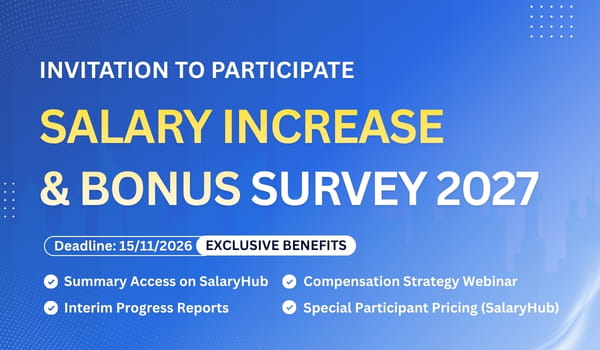
Join the Vietnam Salary Survey 2026 and Make Decisions Based on Real Market Data
The Vietnam Salary Survey 2026 collects actual compensation data from companies across industries and regions nationwide.
The survey provides broad cross-industry coverage for positions that face diverse talent competition, while also offering the depth needed for industry-specific and location-specific benchmarking.
This marks the 17th year ICONIC has conducted the survey. In the 2025 edition, 392 companies participated.
Participating companies receive complimentary access to the summary report, along with additional benefits.
📍 Next Issue (Vol. 5)
"Base Salary, Allowances, and Bonuses: How Should You Structure Compensation?"
Two companies may spend the same total compensation budget but achieve very different outcomes depending on how they allocate pay between base salary, allowances, and incentives.
Compensation structure can significantly affect hiring effectiveness, employee engagement, and cost management.
In the next issue, we'll explore how to design a compensation structure that aligns with both Vietnam's labor regulations and market realities.